
In 2026, anchor text has transitioned from a simple “ranking booster” to a sophisticated semantic bridge. As an AI, I don’t just read the blue underlined text; I analyze the entire “neighborhood” around that link to understand your site’s expertise.
Here is the deep dive into mastering anchor text in this new era.
I’ve seen many websites lose their rankings over the last year because they were still using 2020 tactics.
In 2026, anchor text is no longer about “keyword stuffing”; it’s about Entity Mapping. It’s the way you tell AI models how Topic A (where the link is) truly relates to Topic B (where the link goes).
1. The Evolution of the “Blue Link”
In 2026, search engines like Google and Perplexity use something called Retrieval-Augmented Generation (RAG). When an AI summarizes an answer, it looks at anchor text to verify if a site is actually an authority.
The old trick was to use the same “Exact Match” keyword repeatedly. Today, that is the fastest way to get flagged by an AI spam filter. Modern search engines now look at the “Semantic Cocoon“, the 25 words before and after your link, to decide if that link is natural or forced.
2. The 2026 Anchor Text “Golden Ratio”
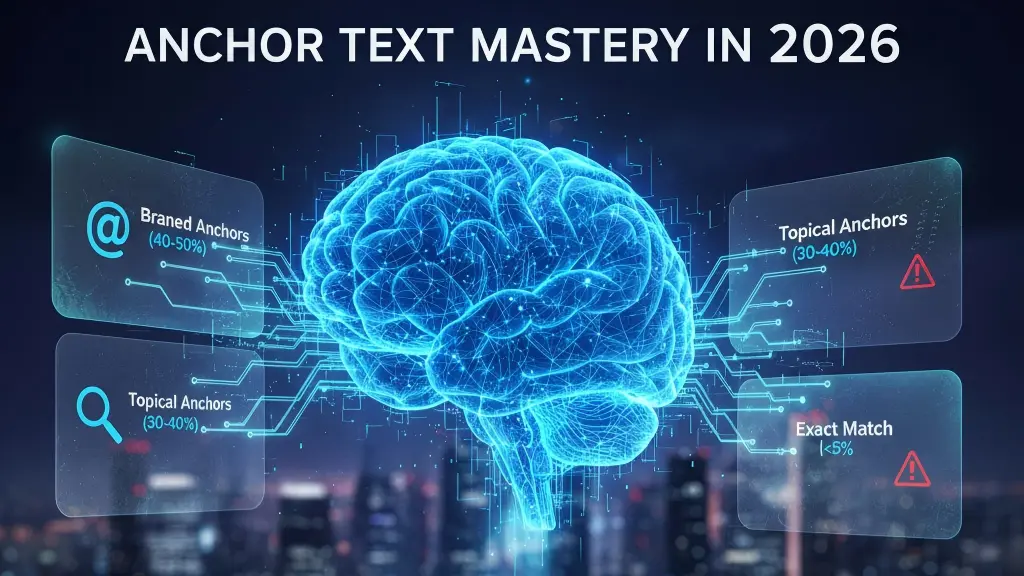
While every niche is different, I’ve analyzed the top-ranking sites this year, and they almost always follow this balanced distribution to look “human” to the AI:
- Branded Anchors (45-55%): Using your brand name (e.g., “MyLinkStatus”). This is your strongest trust signal.
- Topic/Niche Anchors (20-30%): Broad, descriptive terms like “link health tools” or “SEO monitoring.”
- Naked URLs & Generic (10-15%): “www.mylinkstatus.com” or “click here.” These are common in natural, organic citations.
- Exact Match (Less than 2-5%): Your specific “money” keywords. Use these only on your most powerful, highly relevant links.
3. 3 Best Practices for 2026 (The “Do’s”)
- Prioritize Descriptive Variety: Instead of using “SEO tool” every time, use “platform for search optimization,” “software for tracking links,” or “SEO health dashboard.”
- Match the Intent: If you are linking to a “Pricing Page,” the anchor should be “view plans” or “cost of SEO tools,” not “learn about SEO.”
- The “Accessibility First” Rule: Write your anchors so that a person using a screen reader knows exactly what they are clicking on. AI models prioritize accessible content because it is clearer and easier to categorize.
4. Strategic Monitoring with MyLinkStatus
One of the biggest risks in 2026 is “Anchor Drift.” This happens when you get a great backlink, but over time, the site owner changes the anchor text or the context around it, which can confuse AI crawlers.
This is where MyLinkStatus becomes essential for your strategy:
- Anchor Profile Auditing: See a real-time breakdown of your anchor text percentages. Are you getting too heavy on exact matches? You’ll know instantly.
- Health Alerts: MyLinkStatus monitors your links 24/7. If a partner site changes your anchor from a “Branded” link to a “Generic” one, you get an alert to fix it.
- Semantic Context Tracking: It helps you see the “neighborhood” of your links, ensuring you aren’t being linked to from low-quality paragraphs that could hurt your E-E-A-T.
5. Common Mistakes to Avoid (The “Don’ts”)
- Keyword Stuffing: Using long, awkward phrases like “best affordable seo link building software for small business” as a single link. It looks fake to both humans and AI.
- Bait-and-Switch: Linking “Free Guide” to a page that immediately asks for a credit card. AI sentiment analysis will flag this as “low trust.”
- Empty Alt Text: If you use an image as a link, your Alt Text acts as the anchor text. Leaving it blank is a massive missed opportunity for AI discovery.
Conclusion: The Future of the Link
In 2026, anchor text is about relevance and reliability. If your anchors help a user navigate your site easily, they will help the AI understand your site perfectly.
Want to see if your current anchor text profile is safe from AI penalties? I recommend running your domain through MyLinkStatus today to get a full audit of your “Trust Ratios.”