
In 2026, the SEO world has shifted. We are no longer just fighting for the #1 spot on a results page; we are fighting to be the “source of truth” for AI.
For a long time, monitoring how AI models like Microsoft Copilot used our content was like looking into a black box. We knew the traffic was coming in, but we couldn’t see the “why” or the “how.”
That changed on February 10, 2026, when Microsoft officially launched the AI Performance Dashboard within Bing Webmaster Tools.
As someone who has spent the last week digging into this new data, I can tell you: if you aren’t using this dashboard yet, you are flying blind in the age of AI search.
Monitoring Your Website’s AI Performance: A First-Person Guide
I’ve always felt that Bing Webmaster Tools (BWT) was the “hidden gem” of SEO. While everyone obsesses over Google Search Console, Bing has quietly become the leader in AI transparency.
With their new 2026 redesign, they’ve made it easier for regular website owners to understand how AI interacts with their pages.

The History: How We Got the AI Dashboard
It wasn’t always this easy. Back in 2023, Microsoft promised to show us how Bing Chat (now Copilot) used our data.
For two years, we waited. We saw small hints in 2024 and 2025, but the data was always lumped in with regular search traffic.
Finally, in late January 2026, the first “limited” tests were spotted by SEO news sites.
By February 10, 2026, Microsoft rolled it out to everyone. This wasn’t just a small update; it was part of a total “slick redesign” of the interface to focus on the future of the “Answer Engine.”
How to Find and Read Your AI Data
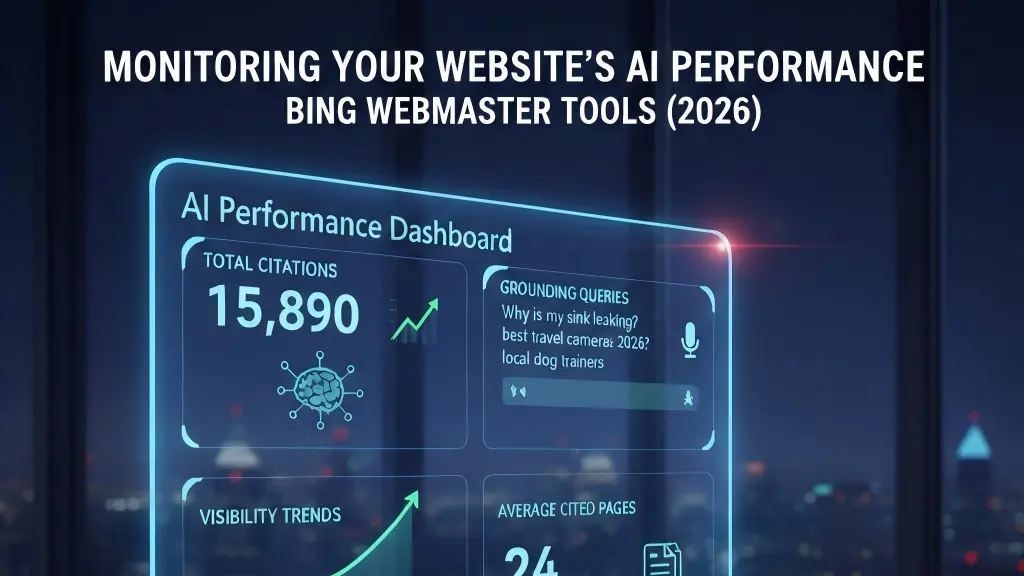
When you log in to Bing Webmaster Tools today, you’ll see a new tab on the left called “AI Performance.”
When I first clicked it, I saw four main numbers that changed the way I look at my content:
- Total Citations: This is the big one. It’s the number of times the AI actually linked to your site as a source.
- Average Cited Pages: This tells you how many different pages on your site the AI likes. If this number is low, the AI might think you are an expert in only one tiny topic.
- Grounding Queries: These are the actual phrases people used that triggered the AI to look at your site. These often look like full questions (e.g., “Why is my sink leaking?”) rather than just keywords.
- Visibility Trends: This is a simple graph. If the line is going up, the AI trusts you more.
A Note on the “Missing” Click Data
As a peer in this space, I should mention that while Bing’s report doesn’t show clicks inside the AI dashboard, most of us in 2026 are “triangulating” this data.
I take my AI Cited Pages list from Bing and cross-reference it with my Google Analytics 4 referral traffic (filtering for bing.com / copilot). It’s a manual workaround, but it’s the only way to see if those citations are actually turning into visitors.
Why Bing Webmaster Tools is Your Secret Weapon
Now, let’s talk about why this tool is a big deal. In 2026, Bing is more than just a search engine; it is the backbone for Microsoft Copilot.
The biggest advantage of BWT is that it gives you data you literally cannot get anywhere else.
It shows you your Generative Engine Optimization (GEO) stats. This tells you whether your site is being used to “ground” (or verify) the AI’s answers to users.
Another huge benefit is IndexNow. This protocol lets your site “push” updates to Bing instantly. In 2026, AI models have a short memory.
If you update a product price or a news story, you don’t want the AI quoting your old version. IndexNow ensures the AI sees your fresh content immediately.
Protecting Your AI Authority with MyLinkStatus
While Bing tells you how your site is performing in AI, you still need to ensure your foundation is solid. AI models prioritize sites that other high-trust websites link to.
However, in 2026, if the links supporting your authority suddenly disappear or turn into “spam,” your AI citations will drop almost instantly.
This is where I naturally integrate into my workflow. While I use Bing to see my AI wins, I use MyLinkStatus to monitor the health of the backlinks that make those wins possible.

By catching these changes early, I can fix my link profile before the Bing AI dashboard shows a downward trend.
The 2026 Verdict
Success in 2026 isn’t just about being #1 in the blue links. It’s about being the Trust Anchor for AI.
Microsoft’s new AI performace dashboard is the first tool that lets us measure that trust. It turns the “black box” of AI into a map we can actually follow.
My advice? Set up your Bing Webmaster Tools account, turn on IndexNow, and start monitoring your AI citations today.
The sites that understand their AI performance now are the ones that will own tomorrow’s traffic.