
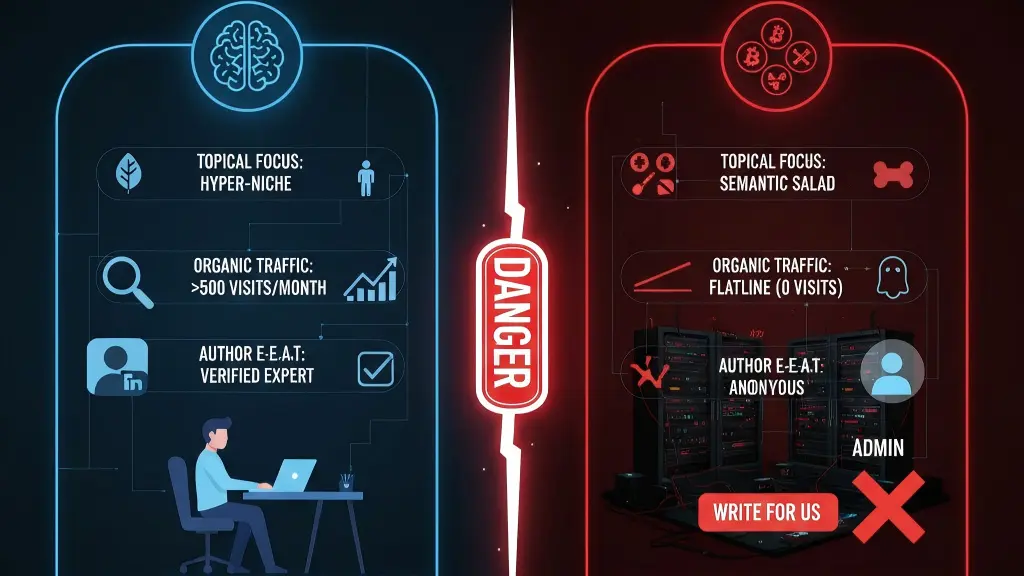
Google’s Adversarial AI is now specifically trained to spot the underlying mathematical patterns that define a farm. If you’re vetting a site for a backlink, you have to look past the design and check the “Entity Signal.”
Here is my personal checklist for spotting a link farm in 2026 before you waste your budget.
Summary: 2026 Quick-Check Table
| Feature | Real Authority (High Trust) | Link Farm (Avoid) |
| Topic | Hyper-focused / Niche | “General” / Covers everything |
| Traffic | > 500 Monthly Organic Visits | Flatline or near zero |
| Authors | Verified experts with bios | “Admin” or Anonymous |
| Outbound Links | Mostly internal & citations | Mostly external “Money” sites |
| Indexation | Fast (Hours/Days) | Slow or non-existent |
How to Spot a Link Farm in 2026: The “Entity” Audit
As someone who spends all day looking at backlink profiles, I’ve seen thousands of sites that look great but carry zero SEO weight. In fact, current 2026 data shows that 89% of SEO experts now identify “topical chaos” as the number one indicator of a site designed purely to sell links.
1. The “Semantic Salad” (Topical Chaos)
A legitimate site builds Topical Authority. A link farm builds Invoices.
- The Red Flag: If the homepage features an article on “The Future of AI” right next to “5 Tips for DIY Plumbing” and “Best Online Casinos in 2026,” you are standing in a link farm.
- The AI Logic: In 2026, Google maps every site into a “Semantic Cluster.” When a site covers too many unrelated topics, its “Trust Score” is diluted.
- The Test: If you can’t describe what the site is about in three words (e.g., “Sustainable Vegan Fashion”), Google’s AI probably can’t either.
2. The “DR-Traffic Disconnect” (The Smoking Gun)
This is the most common trick in the book. Link farm owners use spammy redirects to artificially inflate their Domain Rating (DR) or Domain Authority (DA).
- The Red Flag: A site with a massive DR of 60+ but fewer than 500 monthly organic visitors.
- The 2026 Reality: Google has largely moved away from “authority” as a raw number. It now prioritizes “Human Signals.” If real people aren’t visiting the page, Google’s AI assumes the link has zero value.
- The Benchmark: Always look for a Positive Traffic Correlation. If the DR is high, the traffic should be high. If they don’t match, the numbers are manipulated.
3. The “OBL” (Outbound Link) Leakage
Link farms exist to “leak” authority to buyers. They are essentially sieve-like websites where juice flows out much faster than it comes in.
- The Red Flag: Check the latest 10 articles. If every single article links out to a commercial “money page” (like a law firm or a crypto exchange) using an exact-match keyword, it’s a farm.
- The Ratio: A healthy, high-trust site typically has a 1:50 ratio. One commercial outbound link for every 50 internal or educational links. Link farms often have a 1:1 ratio, which is a massive algorithmic red flag that triggers the “Paid Link Filter.”
4. The “Anonymous Entity” (Zero E-E-A-T)
In 2026, Google wants to know who is talking. AI can generate text, but it can’t (yet) generate a real human history.
- The Red Flag: Articles written by “Admin,” “Staff Writer,” or authors with AI-generated headshots and zero social media presence.
- The “Write for Us” Trap: If a site prominently displays a “Write for Us” link in the main header, it has likely already been flagged by SpamBrain as a link-selling entity. In 2026, 86% of experts consider prominent guest post invitations to be a primary warning sign.
How I Protect My Sites with MyLinkStatus
Acquiring a link is only the first step. Because link farms are inherently unstable, you have to monitor what happens after your link goes live. I rely on MyLinkStatus for two critical reasons:
- Existence Monitoring: Link farms are notorious for “rotating” links. They might keep yours live for 6 months and then overwrite it when a new buyer offers more money. MyLinkStatus sends me an alert the second my link is removed or changed to “No-Follow,” so I can address it immediately.
- Anchor Text Audit: Link farms often force you into using “SEO-heavy” anchors. I use the Anchor Text Audit to make sure these links aren’t pushing my Exact Match Anchor Ratio toward that 20% Penalty Zone. If things look too “optimized,” I know I need to build some branded links to balance the profile.
The 2026 Verdict
In 2026, the era of “buying authority by the numbers” is officially over. Google’s AI has shifted the goalposts from Quantity to Identity.
A link from a “Write for Us” site with a DR of 70, but zero traffic is a liability, not an asset. Conversely, a link from a niche-specific blog with only 400 monthly visitors but a highly engaged human audience is SEO gold.
My final advice for 2026: Treat your backlink profile like a high-end neighborhood. One “link farm” property on your block can bring down the value of the entire street.
Stop chasing metrics and start chasing Human Signals. Use MyLinkStatus to audit your existing neighborhood, clean out the “rot,” and ensure your anchor text stays within the safe 20% limit. If you build your backlink profile based on real human traffic and topical relevance, your rankings will be “AI-proof” for years to come.