
In 2026, the question on everyone’s mind is no longer just “Do I have links?” but “How fast is this link working for me?“
While the web has become much larger, Google’s AI-driven crawlers have also become smarter.
There is now a massive difference between a link being found and a link actually moving your position. If you are staring at your analytics waiting for a jump, you need to understand the realistic 2026 timeline.
Here is the data-backed breakdown of how long it takes for a backlink to affect your rankings this year.
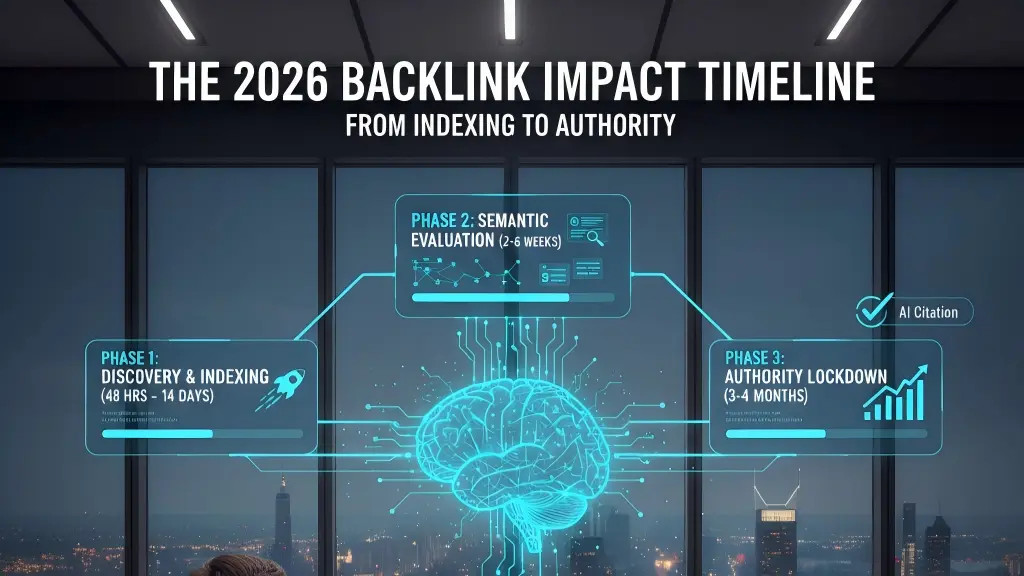
The 2026 Backlink Impact Timeline: From Indexing to Authority
Phase 1: Discovery & Indexing (48 Hours – 14 Days)
Before a backlink can help you, Google’s bots have to find it. This is the “Discovery Phase.” In 2026, indexing speed depends almost entirely on the “Entity Status” of the linking site.
- High-Authority Hubs: If you land a link on a major platform like The Verge or a top-tier industry leader, Google’s real-time crawlers usually find it in under 48 hours.
- The Niche Majority: For the average specialized blog, expect a window of 5 to 14 days.
- The Indexing Gap: Recent studies show that nearly 95% of all web pages have zero backlinks, making new, high-quality links stand out more to crawlers.
Phase 2: The “Semantic Handshake” (2 – 6 Weeks)
Once the link is indexed, Google doesn’t just give you a “point.” In 2026, the AI performs a Semantic Evaluation. It looks at the “Semantic Cocoon”, the 50 words surrounding your link, to see if the reference is helpful or forced.
- The “Nudge” Effect: According to 2026 SEO benchmarks, 80% of specialists report seeing the first “nudge” in search positions within 2 to 6 weeks of a link being indexed.
- The Quality Filter: Google is better than ever at ignoring “link noise.” One editorial link from a high-traffic site is worth more than 1,000 low-quality directory links. In fact, pages ranking #1 have an average of 3.8x more backlinks than those in positions #2–10, but those links are almost exclusively from unique, relevant domains.
Phase 3: The Authority Lockdown (3 – 4 Months)
This is the “real” movement phase. Google often employs a “Rank Transition Algorithm”, a vetting period where it watches for “Link Decay.”
- The 90-Day Rule: Stable, significant ranking gains typically solidify around the 3-month mark. Data from 2025 and 2026 indicates that it takes an average of 3.1 months for the full impact of a new link to be reflected in a site’s “Domain Trust.”
- AI Overview Inclusion: This 90-day window is critical because 75% of links cited in Google AI Overviews come from the top 12 organic rankings. The AI needs this time to “verify” that your new authority is legitimate before citing you as a primary source.
Why Monitoring Is More Critical Than Ever
In 2026, links are volatile. A site might “no-follow” your link after a month, or the page might disappear. Since you’re waiting 10+ weeks for a result, you can’t afford to wait that long only to find out the link was broken in week three.
I personally use MyLinkStatus to manage this. Because link-building budgets have risen to an average of $500 per high-quality link, you are essentially losing money if you aren’t tracking them.
MyLinkStatus sends an alert the second a backlink’s status changes. This way, if a key authority link drops, I can reach out to the editor immediately rather than losing three months of ranking progress.
The 2026 Bottom Line: Patience + Verification
The data is clear: expect early movement in 4 weeks and full, stable impact in 3-4 months.
Patience is a competitive advantage in SEO.
While your competitors are chasing “instant” hacks that lead to penalties, you’re building a foundation that the AI actually trusts.
By the time that 90-day window closes, you aren’t just ranking—you’re becoming a citable authority.
2026 Stats at a Glance
- 3.1 Months: Average time for full ranking impact.
- 3.8x: The backlink advantage #1 results have over #2-#10.
- 73.2%: Of SEOs believe links directly influence AI Search Citations.
- 8.5%: Average response rate for link outreach (personalizing subject lines boosts this by 33%).