
When I first started in SEO, the advice I got was brutal and straightforward: “If it’s not a dofollow link, it’s a waste of your time.”
For years, we all obsessed over “link juice” and ignored any opportunity that came with a nofollow tag attached.
But it’s 2026, and I’m here to tell you that the old “all-or-nothing” mindset is not just outdated, it’s actually dangerous for your site’s health. Let’s break down exactly what these links are and why my strategy for nofollow links has completely flipped.
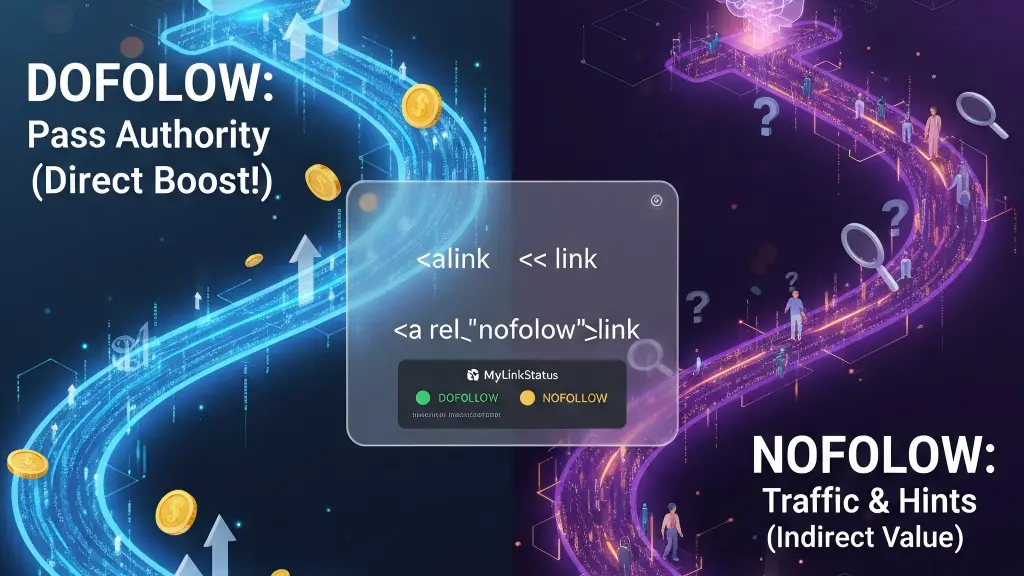
What’s the Real Difference, Anyway?
If you strip away all the jargon, the difference between a dofollow and a nofollow link comes down to a tiny piece of code and a conversation with a search engine.
| Feature | Dofollow Link | Nofollow Link |
| HTML Attribute | None (Default) | rel='nofollow' |
| Passes “Link Juice” | Yes (Directly) | No (Only as a “Hint”) |
| Google’s Interpretation | A vote of confidence and authority. | A reference or “hint” without full endorsement. |
| Impact on Rankings | Direct boost to DA and keyword rank. | Indirect; helps with indexing and brand signals. |
| Crawl Behavior | Search bots prioritize following these. | Bots may follow them if the source is high-authority. |
| Natural Profile | Essential for growth. | Essential to avoid “spam” flags. |
| Common Sources | Editorial articles, guest posts, niche partners. | Social media, Reddit, YouTube, blog comments. |
| Best Usage | High-quality, trusted references. | Sponsored ads, affiliate links, or unverified content. |
The Dofollow Link
Think of a dofollow link as a professional recommendation. When Site A links to Site B without any special tags, they are telling Google, “I trust this content. You should pass some of my authority over to them.” In the industry, we call this passing “link juice.” By default, every link you create is a dofollow link unless you manually change it.
The Nofollow Link
A nofollow link looks identical to a regular link to your readers, but it has a hidden tag: rel= “nofollow”. This tag tells Google, “I’m linking to this page, but I’m not necessarily vouching for its authority.”
Originally, these were invented to stop people from spamming blog comments to get easy rankings. If the link was “nofollow,” the spammer got no SEO credit, so the incentive to spam disappeared.
How do you tell them apart?
Unless you want to spend your whole day right-clicking every link and digging through messy HTML code, you need a faster way to see what’s happening under the hood.
Whenever I’m auditing a new guest post or checking my competitors’ backlinks, I use MyLinkStatus. It’s a simple tool that instantly checks the status of your backlinks so you don’t have to play detective with the source code. It’s been a lifesaver for ensuring the links I’m working hard to build are set up correctly.

Do Nofollow Links Help Your Rankings in 2026?
This is the question I get asked most often. If a nofollow link doesn’t pass authority, why bother?
The truth is: I still want nofollow links, and you should too. Here is why they are still vital for your SEO strategy today.
1. Google Now Uses “Hints”
Back in the day, Google’s “nofollow” instruction was a command: Do not count this. Today, Google treats it as a hint.
If you get a nofollow link from a massive authority like The New York Times or a highly relevant niche forum, Google’s AI is smart enough to see that link and think, “Even though this is nofollow, it’s clearly a high-quality signal.” My experience has shown that these “hints” can and do move the needle on rankings.
2. The “Natural Profile” Test
If I look at a website’s backlink profile and see that 100% of its links are dofollow, a red flag goes up. Real, organic growth doesn’t happen that way.
In the real world, people share your links on social media, in Reddit threads, and in YouTube descriptions, all of which are nofollow. If you don’t have these, Google’s 2026 algorithms might flag your site for “artificial link building.” A healthy mix (I usually aim for a 70/30 split) makes your site look like a legitimate brand rather than an SEO project.
3. The Traffic is Real
At the end of the day, we do SEO to get eyes on our content. A nofollow link on a high-traffic site still sends real human beings to your pages.
- If those people stay on your site, read your articles, and click around, those are positive user signals.
- Google notices when people spend time on your site, and that behavior definitely helps your rankings.
My Final Advice
In 2026, I stopped asking “Is this link dofollow?” and started asking “Is this link relevant?”
A dofollow link from a random, unrelated “link farm” will actually hurt you more than it helps. But a nofollow link from a site your customers actually visit? That’s pure gold. It builds your brand, brings in traffic, and gives Google the “hints” it needs to see you as an authority.
If you aren’t sure what your current link profile looks like, run your URL through MyLinkStatus to see which of your links are passing juice and which are acting as those all-important “hints.”